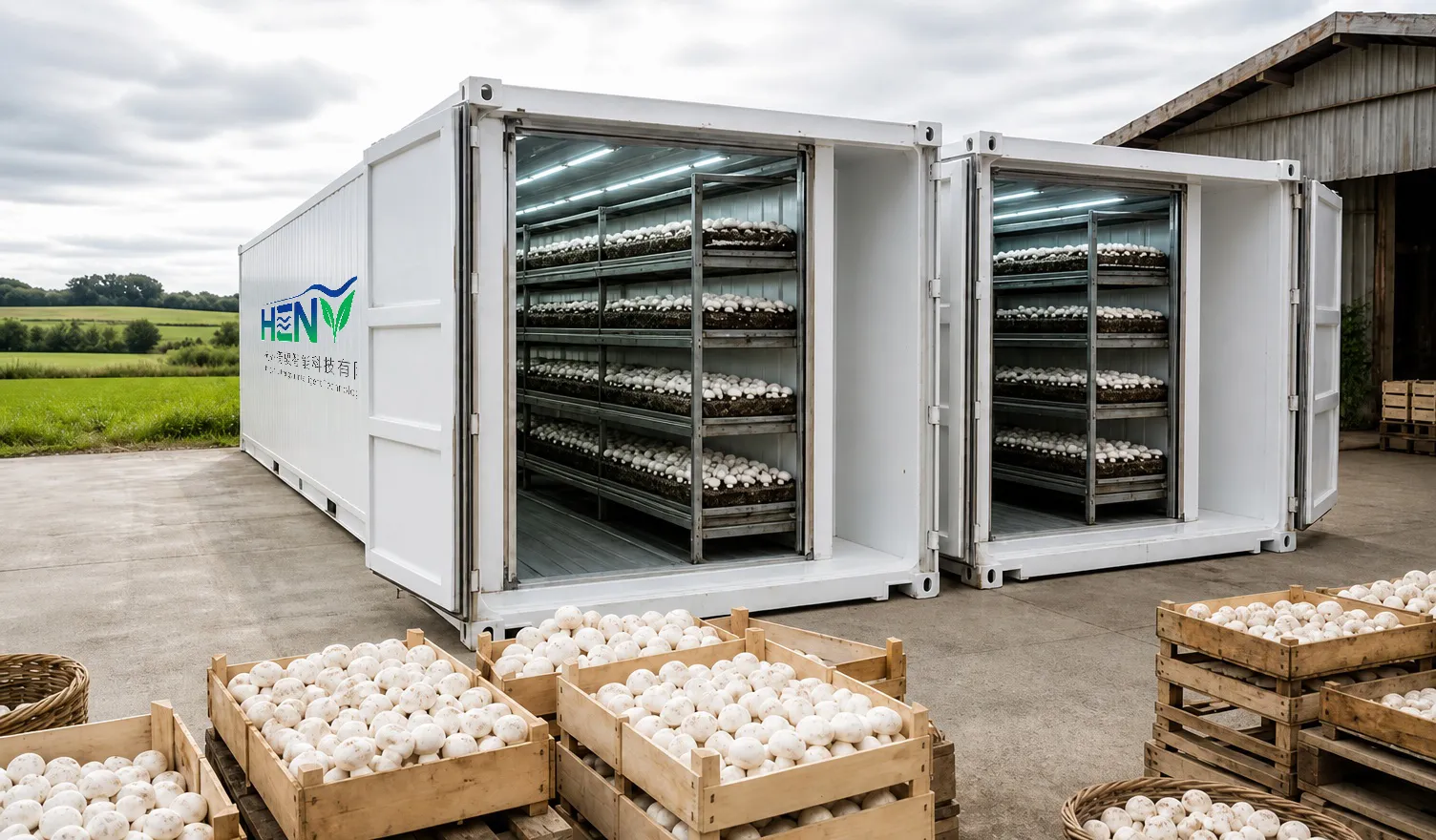
Calling a container farm a factory is not a metaphor. It is the most literal description of what the operation has become. Inside the box, inputs are metered, processes are controlled, output is scheduled, and the person in charge is no longer cultivating a field against the weather but supervising a production line. That reframing buys real advantages—consistency, predictability, repeatability—and it imports two constraints that open-field agriculture never had to confront in quite this form. A factory needs a workforce trained to run process equipment. A factory runs on energy that must be bought every single day. For container farming, these are not secondary considerations. They are the two variables that most often decide whether a unit survives.
From Grower to Process Operator
Industrialisation first changes who works in the farm and what the job asks of them.
A field grower reads land, weather, soil and plant condition, and makes judgment calls shaped by years outdoors. That knowledge is contextual, seasonal and largely tacit—hard to write down, hard to teach, but remarkably effective because the system it operates in is forgiving. A missed irrigation window is a setback, not a catastrophe. A pest outbreak can be managed over weeks. The field absorbs imprecision.
A container's operating manual demands something different. It wants someone who can read sensor logs, act on a threshold alarm, confirm that a dosing pump is calibrated, hold a maintenance schedule, and diagnose why the electrical conductivity drifted overnight. The skill set sits closer to a process technician than to a farmer.
In theory this is a simplification—the box removes the weather, so the operator no longer has to outguess the sky. In practice it swaps one difficulty for another. A sealed, high-density, recirculating environment is unforgiving in a way a field never is. Every plant shares the same water, the same air, the same light. A clogged emitter starves a whole rack. A failing chiller or a CO₂ scrubber that stops working can damage or destroy an entire crop within hours. A nutrient-dosing error propagates through the loop and reaches every root at once. The operator is not managing a field but a closed loop, and closed loops punish small failures severely.
That shift has a psychological dimension that rarely appears in equipment brochures. Field work rewards attention spread across a season. Container work demands vigilance concentrated on a machine, where the feedback is not the look of a leaf but a number on a screen. Not every good grower adapts to it, and not every good technician understands plants well enough to interpret what the numbers mean.
The Scarcity of the Right Operator
The economics then run into a labour-market problem that few business plans confront. There is no established occupational category for container farm technicians, so recruitment draws from two imperfect pools.
Growers understand plants but often lack the electrical, mechanical and data fluency the job requires. Technicians, engineers and food-processing operators have the systems skills but may not know what a nutrient deficiency or a pathogen looks like before it is a spreadsheet anomaly. The role sits at the intersection of horticulture and process engineering, and the labour market does not yet produce people trained for the intersection.
The result is a hiring problem that shows up as an operating problem. A container staffed by someone strong in plant science but weak on equipment tends to run until something breaks, then lose a crop. A container staffed by someone strong on equipment but weak on plants tends to keep the machine running perfectly while missing the early signs of a biological problem. Either mismatch shows up in yield, and yield is the only number that matters.
There is no shortcut around this. Training in-house takes months and risks losing the investment to a competitor. Hiring from the food-processing sector brings systems discipline but a steep plant-learning curve. The operations that do well tend to build the role deliberately—defining it clearly, paying above the local agricultural wage, and treating the technician as a specialist rather than as cheap field labour indoors.
Labour That Cannot Be Engineered Away
The second labour question is structural rather than about individual skill: how much of this can be automated, and how much cannot.
Container farms are frequently sold on the premise of labour reduction. The pitch is seductive—no weeding, no spraying, no tractors, no seasonal crews. What the pitch tends to omit is that the remaining tasks are concentrated in the places automation handles worst.
Seeding, transplanting, harvesting, trimming, packaging and cleaning between cycles are all manipulation tasks involving irregular, deformable, living objects. Robots do these poorly and expensively. Some operations automate seeding and irrigation monitoring; very few automate harvest at commercial quality across multiple crops. And because the container operates in staggered batches to smooth output, the harvest and packing workload arrives daily rather than in bursts that could be absorbed by temporary staff.
This creates a labour profile opposite to conventional agriculture. Open-field operations concentrate labour at planting and harvest, with quiet periods between. A container farm running continuously needs a stable crew every day, and that crew is doing the least automatable work in the system. The labour cost does not scale down with volume; it scales up almost proportionally. There is very little of the economies-of-scale relief that a factory typically expects, because the factory's labour-reducing lever—mechanisation—does not reach the tasks that remain.
There is a second, less visible labour cost: sanitation. A dense, warm, humid, nutrient-rich environment is also an ideal medium for contamination, which is why container operations run strict cleaning, sanitising and access routines. This is unproductive time, it recurs every cycle, and it cannot be skipped without risking a total crop loss.
The Energy Ledger
If labour is the first imported constraint, energy is the second, and it is the one that most directly determines unit cost.
A container farm is an electricity consumer by construction. The sealed box has no free inputs—no sunlight, no rain, no ambient airflow, no natural temperature moderation. Everything the crop receives must be manufactured inside the box, and manufacturing it costs power.
The major loads are these. Lighting dominates in a leafy-green operation, because photosynthesis requires a photosynthetic photon flux density measured in hundreds of micromoles per square metre per second, sustained for twelve to eighteen hours daily. Climate control—cooling, heating and dehumidification—is the second major load, and it never stops, because the box is continuously exchanging heat with the outside and generating heat from its own lights and equipment. Ventilation and air handling represent a third, smaller but continuous draw. Pumps, controls, sensors and fertigation round out the account.
Laid against the output, the number that matters is kilowatt-hours per kilogram of produce. For leafy greens under efficient artificial light, that figure commonly lands in the low single digits to mid single digits per kilogram, with less efficient or higher-light operations running considerably higher. At commercial electricity prices this energy cost can easily equal or exceed the wholesale value of the crop, which is precisely why container produce cannot be sold into commodity channels and must reach buyers who pay a proximity or consistency premium.
The Accounting Traps
Two accounting errors recur in container farm economics, and both flatter the operation.
The first is treating electricity as a variable cost that scales with output. In important respects it does not. The climate system runs continuously, whether the box is at full production or half. Holdings, standby, and conditioning of an idle or partially loaded box still consumes power. A container at fifty per cent utilisation does not halve its energy bill; it may only trim it. This is why the utilisation rate is the single most powerful variable in the cost model—not the price paid per kilowatt-hour. A box running near capacity dilutes a largely fixed energy load across more kilograms. A box running at half load carries the same load across fewer.
The second error is the sustainability claim. Container farms are often marketed as low-carbon because they are local and because they use less water. Water efficiency is genuine: recirculating systems use a small fraction of the water open-field irrigation demands. Local delivery does cut transport emissions, though transport is usually a modest share of a food item's footprint. But the energy that replaces sunlight and weather is not free carbon, unless the grid is clean. In a coal-heavy electricity market, a container farm can carry a higher carbon footprint per kilogram than field-grown produce trucked in from a region with better growing conditions. The claim that a container "saves carbon" is therefore conditional on the power source, and it is not universally true. Being honest about that condition matters, because overclaiming invites exactly the scrutiny that damages the sector's credibility.
What the Factory Framing Actually Requires
Taken together, the labour and energy constraints point to a consistent management conclusion. A container farm should be run like the process plant it is.
That means sizing the workforce around the reality that harvest and sanitation are daily, non-automatable, and skill-dependent—and paying enough to retain a technician who can bridge plants and equipment. It means engineering for reliability, because downtime in a closed loop is a crop loss rather than a delay. It means reading the energy account as a fixed load to be diluted through utilisation rather than as a per-unit cost to be negotiated down. It means treating redundancy in cooling, ventilation and power as a resilience feature rather than an inefficiency. And it means cost modelling on kilowatt-hours per kilogram and labour hours per kilogram, not on optimistic per-square-metre yield claims.
None of this makes the factory framing wrong. It makes it demanding. The container farm's technical promise—a controlled, repeatable, location-independent growing unit—is real, and in the right circumstances it is valuable. But the unit only becomes a business when the two imported constraints are managed with the seriousness a factory manager would give them, because in the factory framing, the crop is not the product. The crop is the output of a machine that must be staffed and powered every day, and the machine is where the money is made or lost.