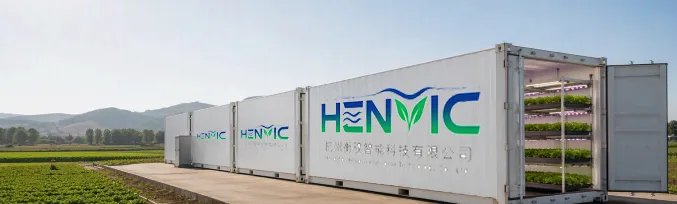
Most container farm business cases fail on the operating line rather than the capital line, and the reason is usually an under-modelled latent load. A sealed cultivation box with dense canopy, high transpiration and continuous lighting is a humidity generator first and a lighting installation second; treating dehumidification as a secondary function of the cooling system is the single most common economic error in the category.
Start with the energy balance. Every watt delivered to the container leaves as sensible heat, latent heat, or stored energy in biomass — and the biomass term is negligible. Lighting at 3.0 µmol/J converts roughly a third of its input to photons and the remainder to heat, so a lighting installation drawing tens of kilowatts imposes a near-equal cooling demand during the photoperiod. Add pumps, fans, dehumidification motors and controls, and the total internal sensible load is straightforward to calculate. The latent load is harder and larger: transpiration scales with canopy area, VPD and light, and in a mature leafy canopy it can approach or exceed the sensible load on a per-square-metre basis. Rejecting that moisture requires either cooling the air below dew point, which overcools and then needs reheat, or a desiccant/enthalpy system that removes water without the temperature penalty.
That distinction is where the economics turn. Coil-based dehumidification has a coefficient of performance that degrades badly as the coil temperature drops; below roughly 4–6 °C coil temperature the compressor is doing work almost entirely for moisture removal and the effective COP can fall into the low single digits. Desiccant systems trade thermal energy for latent removal and can be attractive where waste heat or cheap gas is available, but they add regeneration load and complexity. Neither is universally correct; the right answer depends on climate, electricity tariff structure and crop VPD setpoint, and a design that ignores the climate it will be deployed in is a design that will be re-engineered on site.
Tariff structure often matters more than total kilowatt-hours. Container farms run high, steady loads around the clock, which is unfavourable for demand charges and time-of-use pricing. Shifting the photoperiod into off-peak windows helps, but only if the crop tolerates it and if the shift does not push the dark period into conditions that spike humidity and Botrytis risk. Load shifting by pre-cooling the thermal mass of the root-zone water is a legitimate lever and is underused.
Water and nutrient costs are usually small but not zero, and the disposal side is frequently overlooked. Recirculating systems reduce input cost but concentrate sodium and sulphate, forcing periodic bleed-off that must be managed as wastewater. Condensate recovery is technically feasible and reduces irrigation demand, but it requires treatment and monitoring before it can be returned to a fertigation loop.
The honest unit economics are expressed per kilogram of saleable product, not per square metre or per container. That means the denominator must reflect graded yield after culls, and the numerator must include labour, packaging, seed, substrate, maintenance and the amortised cost of a container whose productive life is shorter than its structural life because equipment cycles out. A container farm producing premium herbs at a high price point can absorb a mediocre energy profile; a commodity lettuce operation cannot, which is why crop selection and energy design have to be decided together rather than sequentially.
Finally, resilience has a cost that should be priced in explicitly. Backup power, spare compressor capacity and redundant sensors are not optional in a system where a four-hour outage can destroy a cycle's value. Budgeting them at the design stage is far cheaper than retrofitting them after the first crop loss.