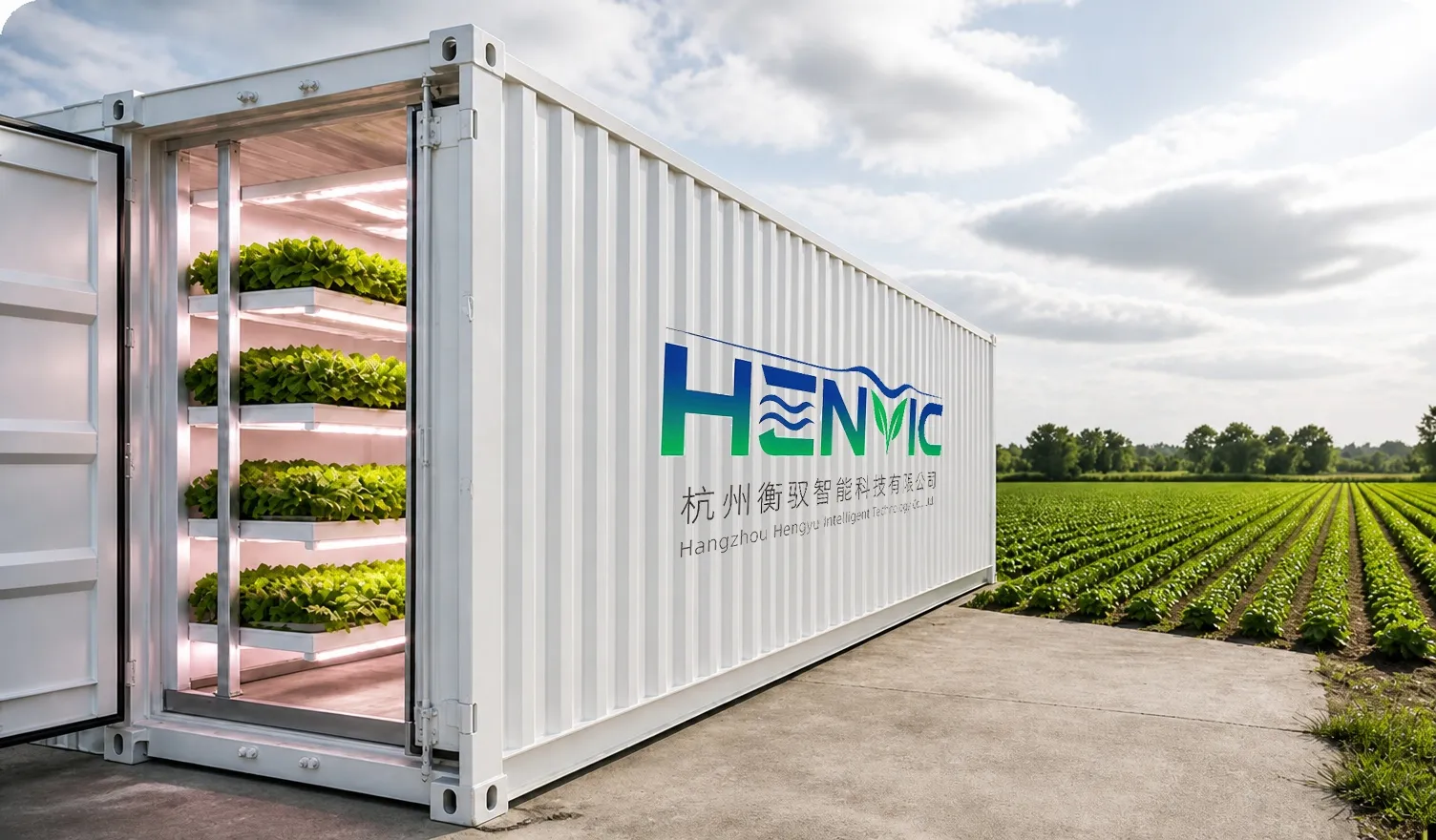
A container farm is a small building in which every environmental variable is decided by a machine. That makes the control system more than a convenience: it is the mechanism by which a recipe is executed identically on Tuesday and on Sunday, by a skilled operator and by a new hire. The value of automation in this setting is not novelty. It is consistency.
What the control system actually does
At its core, a climate computer receives inputs from sensors, compares them with setpoints, and drives actuators to reduce the difference. In a container farm the sensor set is broader and the actuator set more interlinked than in a conventional greenhouse.
Typical sensor inputs include air temperature and relative humidity at one or more heights, carbon dioxide concentration, photosynthetic photon flux density, nutrient solution electrical conductivity and pH, solution temperature, water level, and often leaf-level temperature via infrared measurement. Actuator outputs include compressor staging or capacity modulation, heating valves, humidification or dehumidification stages, ventilation dampers, CO₂ injection valves, lighting dimming, irrigation pump timing and dosing pumps.
The difficulty lies not in any single loop but in their coupling. Cooling removes moisture as a side effect; dehumidification adds heat if a reheat coil is used; lighting adds sensible load and reduces relative humidity; CO₂ injection conflicts with ventilation, which exhausts the gas as well as heat. A climate computer earns its keep by resolving these interactions according to explicit priority rules rather than by letting whichever sensor trips first take control.
Setpoints versus trajectories
Simple systems hold constant setpoints. Better ones execute trajectories — time-varying targets across the crop cycle. A lettuce cycle might specify higher humidity and moderate light during establishment, a VPD band tuned for rapid expansion during the growth phase, and a slightly lower VPD and reduced light near harvest for quality and shelf life.
Trajectories are where agronomic knowledge becomes operational. The point of encoding them is transferability: a recipe developed on one site should produce similar results on another, and a new operator should be able to run a proven crop without years of intuition. The recipe, not the grower, becomes the farm's core asset.
Machines that watch the plants
Environmental control regulates the climate. A second and rapidly developing layer observes the crop itself. Cameras combined with computer-vision models can estimate canopy coverage and leaf area, detect discolouration or lesions associated with disease, measure plant height and uniformity, and track growth rates against expectation.
The practical applications are several. Early disease detection allows intervention before a problem spreads through a recirculating system. Growth tracking allows harvest forecasting weeks in advance, which feeds the scheduling problem directly. Uniformity measurement identifies zones of the container that consistently underperform, pointing to airflow or light distribution faults.
Machine vision is not yet a substitute for a grower's eye in diagnosing novel problems. Its strength is repetition and quantification: it can measure the same forty racks every hour and detect a slow deviation that a human would notice only after it became a loss.
Data as the basis for improvement
A container farm generates a continuous stream of data, and its long-term competitiveness depends on using it. The relevant metrics are operational rather than environmental: kilowatt-hours per kilogram of harvested produce, cubic metres of water per kilogram, labour hours per rack, cycle days from sowing to harvest, and yield per square metre per week.
Tracking these over time reveals where the losses are. A creeping increase in energy per kilogram usually indicates a degrading envelope, a fouling cooling coil or a fixture losing output. A lengthening cycle points to nutrient drift or a climate deviation. A rising labour figure per rack suggests a harvest or handling bottleneck.
The discipline is to define a small number of metrics, measure them consistently and review them against a target. Farms that operate on intuition tend to plateau; farms that operate on measured cost per kilogram continue to improve, because they can see which interventions actually moved the number.
Redundancy and failure response
Automation must be designed for the conditions it will face, including component failure and power interruption. A container farm has no buffering environment to fall back on: if the climate system stops, the crop is in a sealed box with no ventilation and rising temperature.
Practical requirements include alarms that reach a person, not just a screen; battery or generator backup for controls, pumps and critical sensors; redundancy in circulation pumps for hydroponic systems where stagnation is rapidly fatal; and fail-safe positions for dampers and valves. Remote monitoring allows a fault to be diagnosed before someone drives to the site.
The most valuable automation feature in many farms is not sophisticated control logic but a reliable alarm path. A control system that silently fails is worse than a manual one.
Integrating the pieces
The mature container farm runs lighting, climate, irrigation and fertigation through a single supervisory layer, with data flowing to one historian. This integration allows the interactions that matter to be managed explicitly: dimming lights when the cooling system approaches capacity, reducing irrigation frequency in low-VPD conditions, delaying CO₂ injection until ventilation cycles are complete.
Integration also creates the conditions for optimisation rather than mere control. Once the full dataset exists — setpoints, actuator states, environmental conditions, resource consumption and harvest results — the farm can begin to test hypotheses: whether a different DLI produces better economics, whether a modified VPD band improves shelf life, whether staggered lighting reduces peak demand charges without reducing yield.
Where the technology is going
Several directions are clear. Predictive control, in which a model of the thermal and humidity dynamics anticipates disturbances and acts pre-emptively rather than reactively, reduces both setpoint deviation and energy use. Digital twins of the container allow recipe changes to be simulated before they are applied to a crop. Edge computing puts models on the controller so that classification and decision-making happen locally, without depending on a network link.
None of these changes the fundamental requirement, which is that the farm must be able to execute a recipe reliably and to measure whether it worked. Automation and data are the means by which container agriculture turns a promising controlled environment into a repeatable, improvable production system — and that, rather than any individual sensor or actuator, is what the technology is really for.