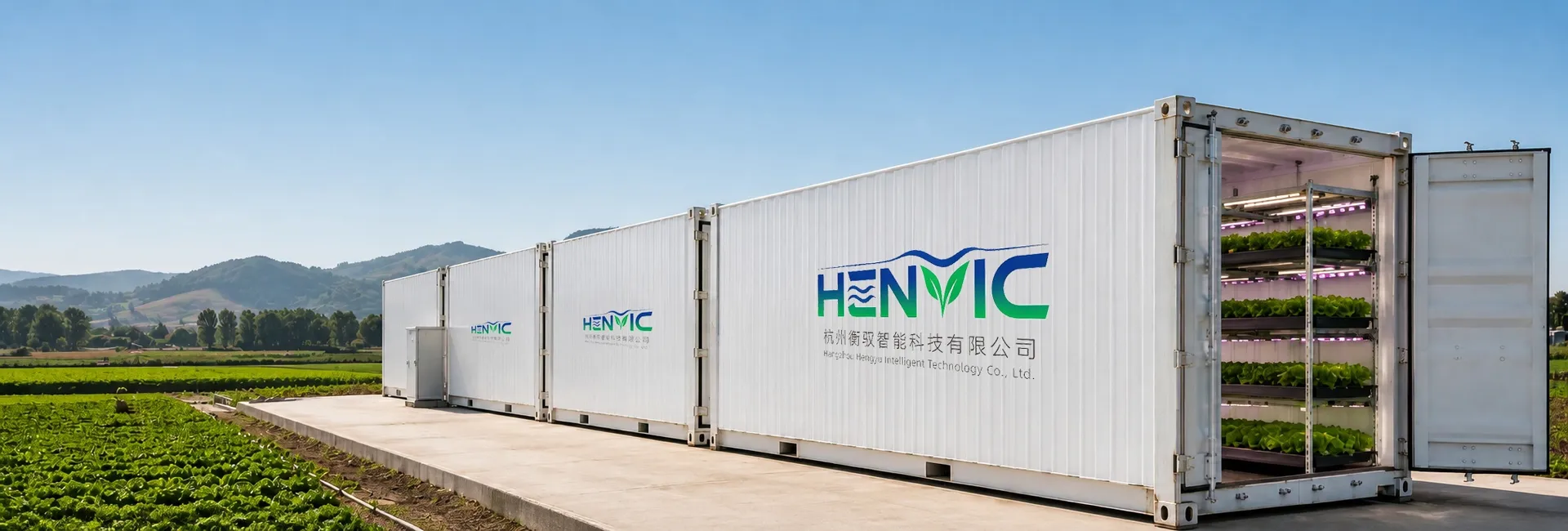
Inside a container farm, sunlight does not exist. Every photon a plant receives is generated by an LED and delivered according to a program. This makes lighting the single most consequential design decision in a container system—and one of the most misunderstood.
Plants do not respond to light as brightness. They respond to photons within specific wavelength ranges, absorbed by pigments such as chlorophyll a and b, carotenoids, and phytochromes. The blue region (roughly 400–500 nm) drives vegetative growth, compactness, and stomatal behavior. The red region (600–700 nm) powers photosynthesis and biomass accumulation. Far-red light (700–750 nm) influences stem elongation and, through the Emerson enhancement effect, can raise photosynthetic efficiency when combined with red.
LEDs became dominant because they allow this spectrum to be engineered rather than accepted. A leafy-green recipe might emphasize red with a smaller blue component to control leaf shape. A fruiting crop like tomato or strawberry typically needs higher total intensity and a broader spectrum, including far-red, to support flowering and fruit set. Recent research has also revisited green light (500–600 nm), long dismissed as inefficient, for its ability to penetrate deeper into the canopy and regulate shade-avoidance responses.
Intensity is expressed as PPFD—photosynthetic photon flux density, in micromoles per square meter per second. Leafy greens generally thrive in the range of 200–400 µmol/m²/s; fruiting crops may demand 600 or more. Photoperiod, typically 14 to 18 hours, sets daily light integral (DLI), the total photons delivered per day. DLI, not instantaneous intensity, is often what actually governs yield, and tuning it is one of the most direct levers available.
Two engineering realities complicate the physics. First, fixtures generate heat, and in a sealed box that heat must be removed or it becomes a cooling load—sometimes the dominant one. Second, all LEDs depreciate. A recipe validated at installation slowly drifts as output falls, unless compensation is built into the control system. Both factors mean that lighting design in a container farm is inseparable from thermal and control design.
The frontier now is dynamic lighting: adjusting spectrum and intensity by growth stage, or even by time of day and electricity tariff, rather than holding one recipe constant. A crop might receive a high-blue morning signal, a red-dominant midday peak, and a far-red end-of-day treatment to shape architecture. Doing this well requires crop-level phenotyping and closed-loop sensors—which is why lighting research and data science are converging.