1. Introduction
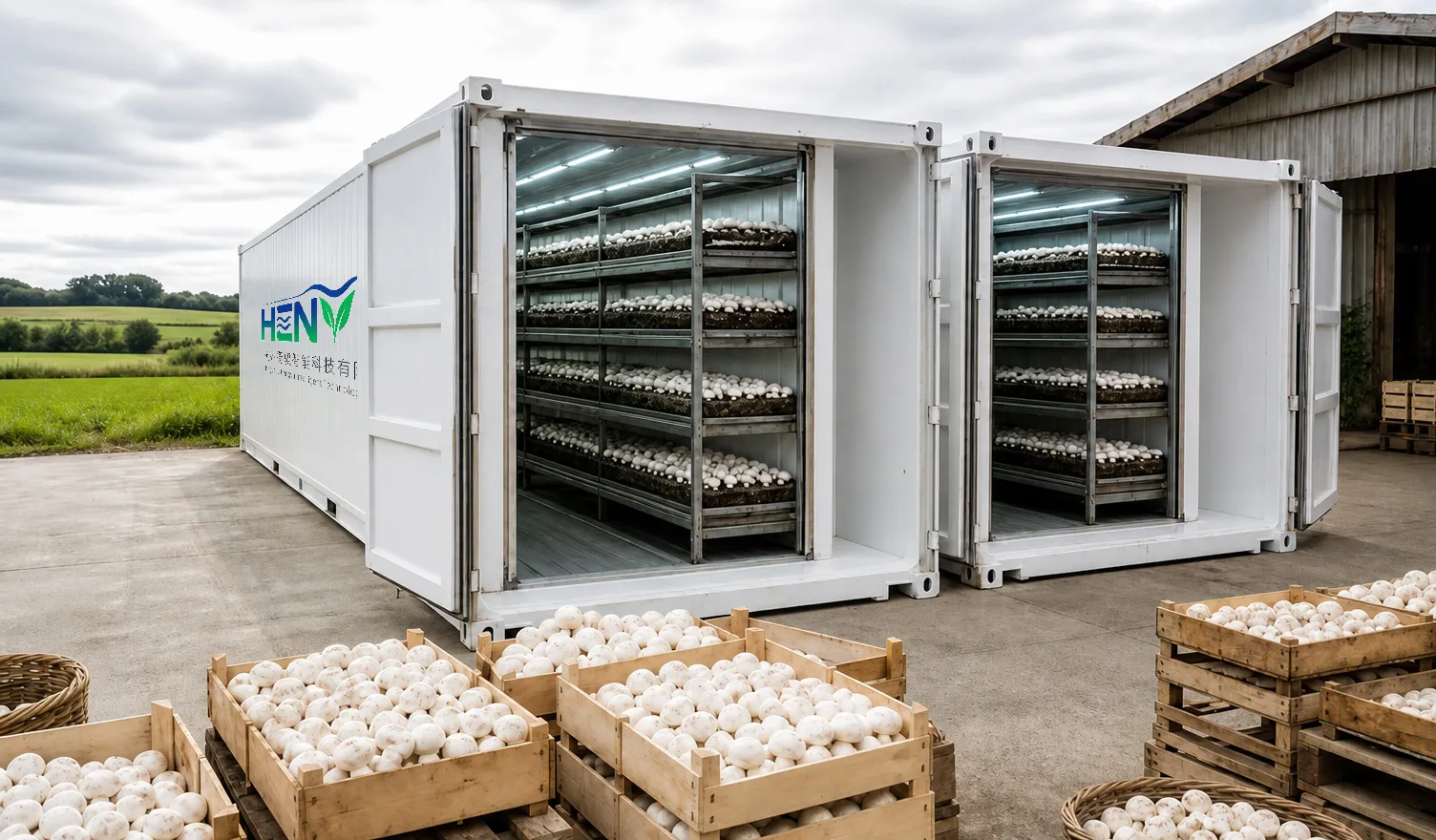
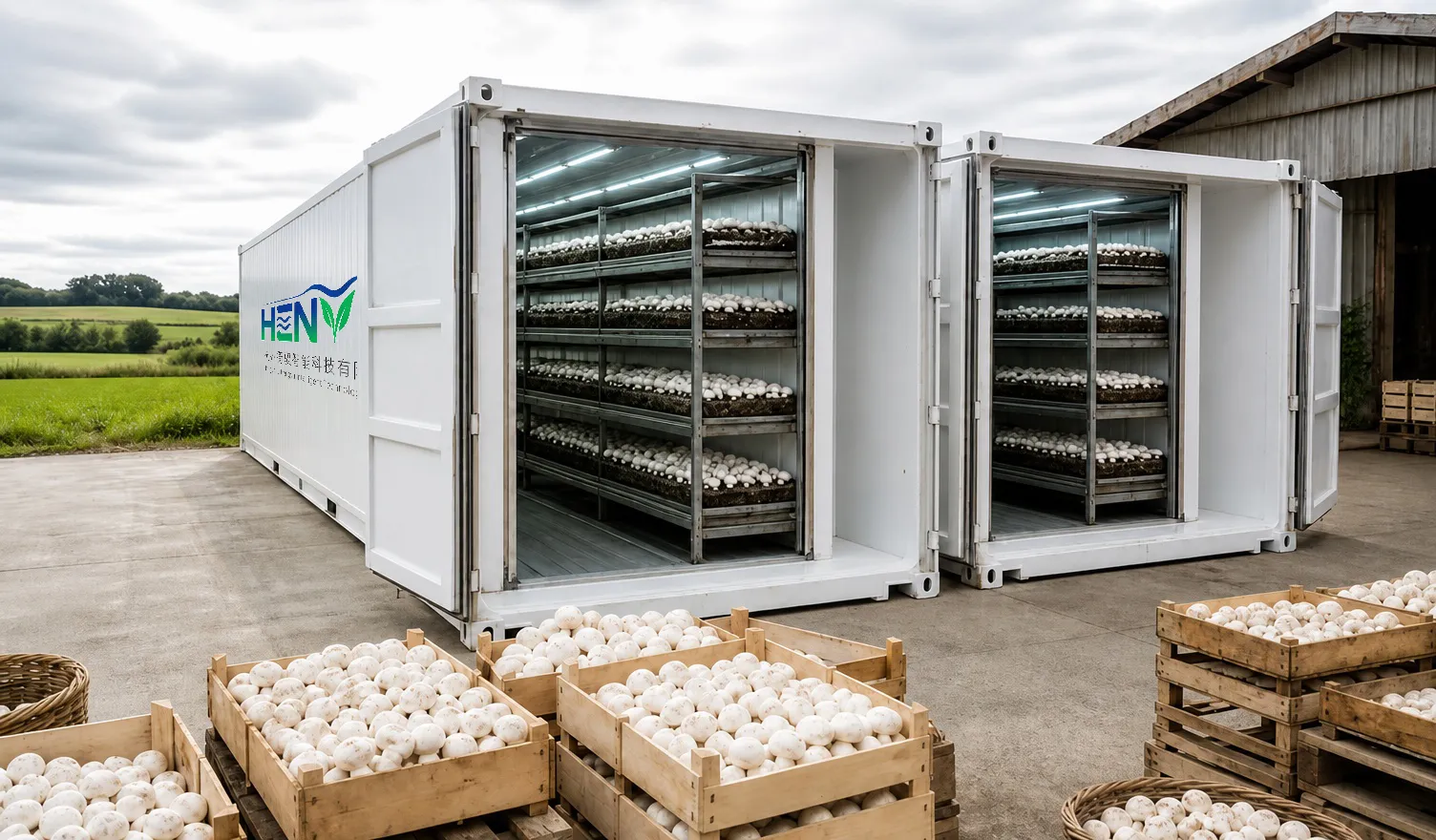
Mushrooms are perhaps the ideal crop for containerized farming. A mushroom fruit body is approximately 90% water, and its formation depends on a set of environmental conditions far narrower than those for almost any plant: relative humidity must sit at 80–95%, temperature must hold within a species-specific band, carbon dioxide must be scrubbed away continuously during fruiting — yet allowed to accumulate during the preceding colonization phase — and light must remain dim, indirect and spectrally minimal. A standard shipping container, retrofitted with insulation, humidification capacity, ventilation control and a sensor network, becomes a vessel perfectly suited to these requirements: sealed, stackable, deliverable anywhere, and capable of holding the high humidity that fungi demand without the energy penalty of an open greenhouse. For both commercial growers and emergency food production, the smart mushroom container turns a steel box into a controlled fruiting chamber.
2. The Four Environmental Pillars
Humidity is the master parameter. Most cultivated species fruit at 80–95% relative humidity; oyster mushrooms drop below that, stems lose turgor and aborted pins. In an insulated container, ultrasonic humidifiers, misting systems or evaporative reservoirs paired with hygrometers and humidistat controllers maintain this envelope continuously. Because mushrooms transpire heavily through their fruit bodies, humidity control is also the primary defense against the fruit surface drying out.
Temperature determines the species and the phase. Grey/blue oyster mushrooms fruit at 10–20 °C, shiitake at 12–20 °C, button mushrooms at 12–16 °C, and lion's mane at 15–24 °C — with pink oysters, one of the fastest-growing species, fruiting at 21–29 °C and going from pin to harvest in 3–5 days. A container's HVAC must cover the full operating band of the chosen species, and preferably several, since most growers run more than one crop.
Fresh air and CO₂ define fruit quality. Fungi respire heavily. During colonization, elevated CO₂ — often above 5,000 ppm — suppresses contaminant organisms and directs mycelial growth into the substrate; during fruiting, however, ambient CO₂ must fall below roughly 800 ppm, otherwise fruit bodies produce long, spindly stems with small or absent caps. A practical rule: oyster mushroom fruiting requires fresh air exchange roughly 2–5 times per hour, depending on species and block density. This two-phase CO₂ requirement — tight, unventilated for incubation, aggressively ventilated for fruiting — is the single most important operational distinction in container mushroom production.
Light is minimal and indirect. Mushrooms do not photosynthesize. Direct sunlight is harmful; low, indirect light is sufficient for cap development and harvest visibility. Containers therefore run in near-darkness during colonization and switch to very dim ambient light during fruiting.
| Species | Fruiting temperature | Humidity | CO₂ during fruiting | Cycle notes |
|---|---|---|---|---|
| Grey/Blue Oyster (Pleurotus ostreatus) | 10–20 °C | 80–95% | <800 ppm, 2–5 ACH | Cold-tolerant; first flush 7–14 days; 2–4 flushes per block |
| Pink Oyster (Pleurotus djamor) | 21–29 °C | 85–95% | <800 ppm | Fastest: 3–5 days from pin to harvest; daily checks |
| Shiitake (Lentinula edodes) | 12–20 °C | High | <800 ppm | Hardwood logs/blocks; months to first fruiting; long-lived |
| Button (Agaricus bisporus) | 12–16 °C | 85–90% | <800 ppm | Compost substrate; demands sterility; prone to green mould |
| Lion's Mane (Hericium erinaceus) | 15–24 °C | Very high | <800 ppm | Hardwood sawdust blocks; warm-season crop |
3. The Two-Phase Cultivation Cycle
Every mushroom container runs on a two-phase regime. Phase 1 — colonization: spawned substrate blocks (straw-based for oysters, hardwood sawdust for shiitake and lion's mane, compost for button mushrooms) are held dark, warm and relatively unventilated while mycelium consumes the substrate; the high-CO₂ atmosphere suppresses contamination. Phase 2 — fruiting: colonized blocks move into the fruiting zone, where humidity is raised to 80–95%, fresh-air exchange is increased to scrub CO₂ to below 800 ppm, and light is dimmed to indirect. The container's control logic must switch cleanly between these two modes — typically a scheduled or sensor-triggered transition — because the environmental requirements of the two phases are almost inverted.
4. Substrate and Spawn Systems
Substrate choice shapes the whole container design. Oyster mushrooms grow on pasteurized straw or supplemented sawdust blocks; shiitake and lion's mane on hardwood sawdust; button mushrooms on compost that must be sterilized — a level of hygiene control far stricter than for any other cultivated species. Spawn is produced in a separate, sterile handling area and introduced to blocks before they enter the fruiting container. This separation of spawn room from fruiting room is essential: contaminant spores entering through unfiltered intake air are the most common cause of crop loss in enclosed systems.
5. Container Architecture for Fungi
A mushroom container differs from a plant-factory container in its emphasis. The thermal envelope and humidification system are the same; what changes is the ventilation strategy and the filtration. Intake ports carry foam or HEPA filtration to reduce contaminant load; exhaust fans run on timers or CO₂ controllers, not continuously, to hold the high-CO₂ incubation atmosphere during Phase 1 and then scrub aggressively during Phase 2. Inside, substrate blocks stack on multi-tier racks, maximizing volume per square metre while maintaining airflow around every block. Blackout capability — the ability to run fully dark for extended periods — is a design requirement, not an option.
6. The Intelligence Stack
The "smart" in smart mushroom container sits in three layers. Sensing: distributed RH, temperature and CO₂ sensors — humidity sensors being the most critical — plus substrate moisture probes, streamed in real time. Control: edge controllers run humidistats for humidifier output, CO₂ controllers for ventilation rate, and thermostats for heating and cooling; lighting schedules are set by photoperiod and species. Monitoring and AI: cloud-connected gateways allow one operator to supervise multiple containers, while historical data from successive flushes feeds models that predict flush timing, flag mold risk early and tune setpoints. In commercial deployments, sensor-driven precision means each flush is logged, traceable and reproducible — effectively giving fungi a digital life record.
7. Troubleshooting and Quality Control
- Long, thin stems with small caps: CO₂ above ~800 ppm — increase fresh-air exchange rate.
- Dried-out blocks or aborted pins: humidity below ~80% — raise humidification or reduce air movement at the fruiting surface.
- Mould outbreaks: stagnant, oversaturated air or contaminated substrate — improve ventilation, tighten spawn hygiene; for button mushrooms, tighten sterility and temperature control.
- Slow or absent fruiting: temperature outside the species window, or mycelium still immature — verify colonization before switching to fruiting conditions.
8. Conclusion
The smart mushroom container is, at its core, a biologically tuned climate machine that must hold 80–95% humidity, a species-specific temperature band, CO₂ below roughly 800 ppm during fruiting and near-darkness — and switch cleanly between an sealed incubation mode and an open fruiting mode. The simplest chambers achieve this with physics alone; the smart container does it with sensors, ventilation control and cloud monitoring. Fungi evolved to fruit at the intersection of moisture and moving air; the container is simply an engineered re-creation of that moment — one that can be delivered, parked and operated anywhere a steel box can go.